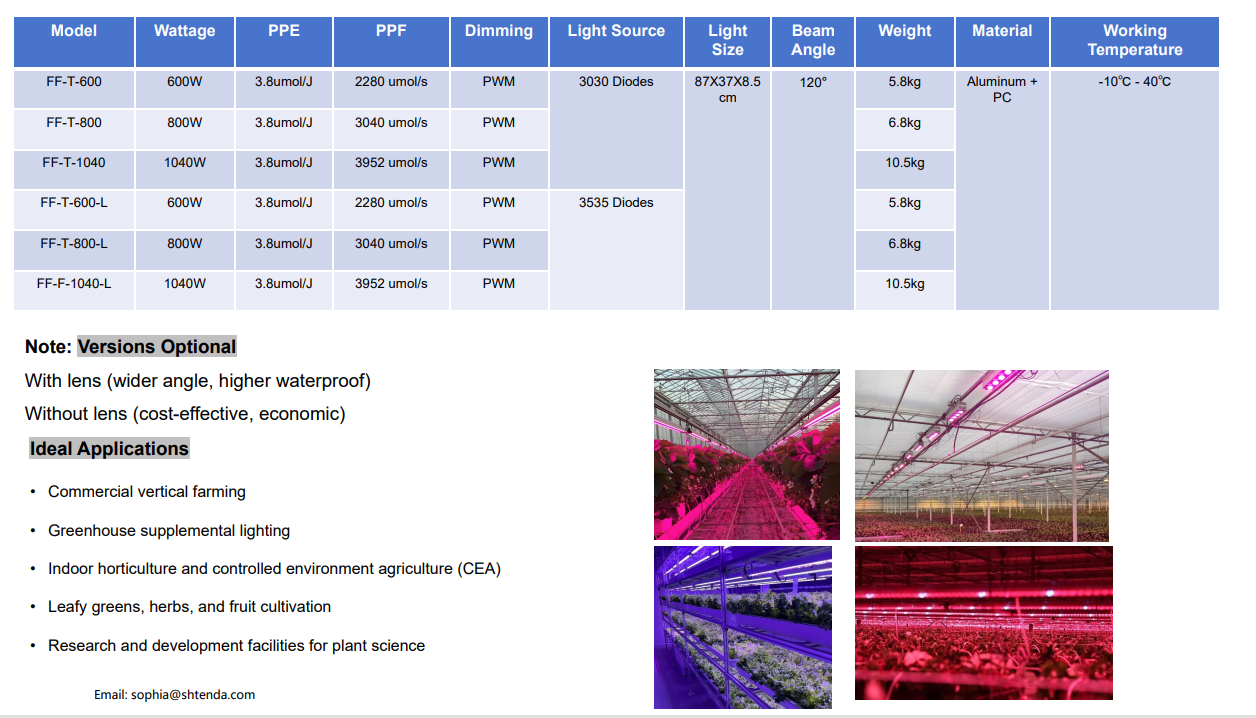
Lens vs Non-Lens - Advantages, Disadvantages & Cost Comparison
1. Core Difference in One Sentence
With Lens: Light is concentrated, directional, and has a long range.
Without Lens: Light is diffused, soft, and has a large coverage area.
2. LED Lights With Lens
Advantages
1.High Light Utilization & Higher PPFD: Light is directed precisely onto the crop canopy, avoiding waste on walkways, greenhouse walls, or empty spaces.
2.Suitable for High Mounting Height (4.5–6m)
3.Strong Light Penetration: Tomatoes/Cucumbers are tall-stemmed with dense foliage; lens-focused light can penetrate to the middle and lower leaves, improving overall photosynthesis efficiency.
4.Controllable & Uniform Light Spot: Available in medium-beam or wide-beam designs, making layout calculation straightforward and engineering standardization easy to achieve.
Disadvantages
1.Granular Light Spot: Close-range installation may result in visible granular light spots, leading to local over-illumination if mounted too low.
2.Slightly Higher Heat Dissipation Requirements: Lens concentration leads to higher local light density, resulting in slightly higher lamp board temperature.
3.Higher Cost: Additional costs for molds, optical design, and lens materials increase the unit price.
3. LED Lights Without Lens (Bare Board/Soft Light)
Advantages
1.Extremely Soft Light & No Glare: Full-surface illumination, similar to panel lights, providing comfortable visual experience.
2.No Crop Burn at Close Range: Suitable for low mounting height (2–3.5m), leafy vegetables, and seedling cultivation.
3.Lower Cost: Eliminates the cost of lens materials and related manufacturing processes, with unit price 10%–25% lower than lens-equipped lights.
4.Better Heat Dissipation: Exposed LED chips have a larger heat dissipation area, reducing overheating risks.
Disadvantages
1.Diffused Light & High Waste: A large amount of light is scattered into the air, walls, or ground, resulting in low effective PPFD.
2.Unsuitable for High Mounting Height (>4.5m): At your 5m mounting height, light attenuation is severe when reaching the crop canopy, requiring significantly more lights to meet the target PPFD.
3.Poor Canopy Penetration: Light only reaches the top leaves, leaving the middle and lower leaves of tomatoes under-illuminated.